Tampilkan postingan dengan label World. Tampilkan semua postingan

Sabtu, 11 Oktober 2014

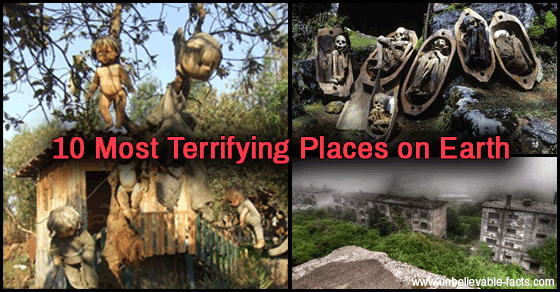
10 Of The Most Creepy Spots On Earth

There are a lot of reasons that make a place creepy: it could be a terrifying history, the eerie sense of unease a place gets when abandoned or its ominous architecture. That however does not deter us, especially the adventurous type, from wanting to visit these places. There’s something fascinating about checking out a creepy place and the adventurer in us just wants to confirm that we don’t scare easily. 
10 Of The Most Creepy Spots On Earth
So just in case you are in the mood to taunt death in the future, Here are some terrifying places you can visit.

1. Island of the dolls in Mexico.
 Island of the dolls in Mexico.
Image Source: www.take-a-pause.net
This place ranks among the freakiest places you could ever find yourself in. Thousands of old battered dolls can be found hanging from trees and they cover the entire island.(source)

2. Winchester House
Winchester House
Image Source: www.take-a-pause.net
The Winchester house looks like a relatively normal old mansion from the outside, but Sarah, widow of the former residence of gun magnate, William Manchester, believed the house was haunted by gun victims of his husband. She kept building bizarre stairs and doors that led nowhere so as to try and keep the ghosts from ever finding her.(source)

3. Leap Castle in Ireland
Leap Castle in Ireland
Image Source: www.take-a-pause.net
Located in Ireland, the castle has a bloody history of violent rivalries and executions. It is thought to be haunted to this day, especially after a team of renovators discovered a pit full of spikes and human remains, not so long ago.(source)

4. Matsuo Mine in Japan
Matsuo Mine in Japan
Image Source: www.take-a-pause.net
Matsuo mine was once a bustling sulfur mine before it was abandoned. If you would like to check it out now, you would be met by a giant wall of mist constantly hiding it from view. This makes it look like a scary ghost town.(source)

5. Centralia in Pennsylvania
Centralia in Pennsylvania
Image Source: www.take-a-pause.net
A mine fire in Centralia has been burning since 1962 and has left the town abandoned almost entirely. The place looks like a cut scene from the Silent Hill game. In fact, Centralia was one of the inspirations for the game.
Read more here: 50 years on, the fire still lingers..

6. Candido Godoi in Brazil
Candido Godoi in Brazil
Image Source: www.take-a-pause.net
On first sight, Candido Godoi looks like a fairly normal town in Brazil but if you take a closer look, you realize the town is swarming with twins. In fact, rumors say that a Nazi geneticist fled to this town after the war. He started experimenting on the population and this is what triggered the phenomenon.(source)

7. Kabayan in Philippines
Kabayan in Philippines
Image Source: www.take-a-pause.net
Kabayan is home to several caves that contain hundreds of mummified corpses. It’s a good place to visit if you really want to have nightmares.(source)

8. Overtoun Bridge in Scotland.
Overtoun Bridge in Scotland
Image Source: www.take-a-pause.net
You may want to avoid this place if you are a dog lover. Dogs leap to death for no apparent reason and dozens of them have killed themselves over the last half century.(source)

9. Body Farm in Tennessee
Body Farm in Tennessee
Image Source: www.take-a-pause.net
“Body farm” is actually a facility in Tennessee used as a training ground for the FBI and other forensic experts. They use it to determine time of death, cause of death etc., and they use real donated cadavers. This means that the place is full of dead bodies.(source)

10. Bannerman Castle in New York
Bannerman Castle in New York
Image Source: www.take-a-pause.net
Bannerman castle is a long abandoned residence that sits in the middle of the Hudson River, New York. It was built by Francis Bannerman, a man who spent his time in this fortress, collecting a huge amount of military grade weaponry.(source)
Check out some more articles:

Jumat, 10 Oktober 2014

7 Laboratories Located In Some Of The World's Most Extreme Environments

Researchers will go to extremes in order to get results. They will get out of their comfort zones, or out of our planet in the name of science. The laboratories discussed below are some where scientists have to work in the most difficult conditions, on the planet and sometimes off it, on mountaintops, at the poles or under water.Their work helps us better understand our universe and get valuable information on the weather, the human body, climate change and many other things.


7 Laboratories Located In Some Of The World's Most Extreme Environments

1. IceCube Neutrino Observatory, Antarctica
IceCube Neutrino Observatory, Antarctica
Image credit: Emanuel Jacobi/NSF (taken from)
It’s the coldest physics laboratory in the world. Equipment used to detect very high energy neutrinos (these are subatomic particles that are known to originate from some violent astronomical phenomena e.g., exploding stars) are not telescopes in space. In fact, they an array of sensors located deep below the surface of the earth. In the frozen wastes of the Antarctica, you will find the IceCube Neutrino Observatory located under a thick ice layer. The neutrinos sometimes react with molecules in the water to produce Cherenkov radiation that is picked up by PMTs (the photomultiplier tubes).
IceCube Neutrino Observatory, Antarctica
Image credit: Patrick Cullis/NSF (taken from)
Creation of IceCube involved the positioning of Digital Optical Modules (DOMs), which are spherical sensors that contain PMTs, at depths of between 1450 and 2,450 meters (4747 and 8038 feet). The Digital Optical Modules range over 1 cubic kilometer of ice which makes them part of the coldest physical laboratory and the largest neutrino observatory in the world. Raw data they collect at the observatory is approximately one terabyte daily which is around 1000 gigabytes, transmitted for analysis.(source:1,2,3)

2. Long Island’s Brookhaven National Laboratory, New York, USA
Long Island’s Brookhaven National Laboratory, New York, USA
Image credit: Brookhaven National Laboratory (taken from)
It’s the hottest temperature producing laboratory in the world. The Relativistic Heavy Ion Collider (RHIC) found at the Brookhaven National Laboratory, announced in February 2012, the production of temperature of around 4 trillion degrees Celsius (7.2 trillion degrees Fahrenheit). This is the hottest temperature man has ever created! It’s 250,000 times greater than the heat found at the earth’s center. This was achieved by the collision of gold ions at close to the speed of light, and quark-gluon plasma- which is a soup of elementary particles that existed in nature a fraction of a second after the Big Bang- was created.
Long Island’s Brookhaven National Laboratory, New York, USA
Image credit: Brookhaven National Laboratory (taken from)
It’s the second most powerful heavy ion collider when compared to the Large Hadron Collider at CERN. The RHIC facility is also the only one where polarized protons are collided so as to study how protons obtain their spin. It’s the world record holder for the highest energy polarized protons to ever be seen and in addition, it produces record- breaking temperatures.(source:1,2,3,4,5)

3. Sagarmatha National Park’s Pyramid Laboratory in Nepal
Sagarmatha National Park’s Pyramid Laboratory in Nepal
Image credit: YouTube/Lorenzo Pini (taken from)
It’s the highest terrestrial laboratory in the world. In the Himalayas, at the Sagarmatha National Park in Nepal, there stands a pyramid shaped laboratory that is three storeys high. The laboratory and observatory is made out of steel, glass and aluminum. It’s located at the base of Mount Everest at 16,568 feet or 5,050 meters above sea level. The research done here is on subjects like human physiology, geology, the environment and climate.
Sagarmatha National Park’s Pyramid Laboratory in Nepal
Image credit: YouTube/Lorenzo Pini (taken from)
The laboratory was created by the Ev-K2-CNR committee, which is dedicated to the promotion of technical and scientific altitude research. It has three levels: laboratories and warehouses are on the first two levels while the third level is devoted to telecommunications and data processing. The pyramid is a landmark to scientists and also to locals who use its telecom facilities sometimes.(source:1,2,3,4,)

4. The NOAA Aquarius Reef Base, Florida Keys National Marine Sanctuary in Florida, USA.
The NOAA Aquarius Reef Base, Florida Keys National Marine Sanctuary in Florida, USA.
Image credit: NASA (taken from)
It’s the deepest underwater laboratory in the world and one of its kind. This is because other undersea laboratories like the Conshelf III and a Conshelf II cabin that were operational during the 1960s, went beneath the waves. The Aquarius lab is around 50 to 60 ft (which is about 15 to 18 meters) below the surface of the water in a marine sanctuary at Florida Keys. It has been used to study the ecology of the reef by researchers for the last two decades. Facilities in the laboratory include six bunks that have a bathroom plus windows that are onto the watery world outside.
The NOAA Aquarius Reef Base, Florida Keys National Marine Sanctuary in Florida, USA.
Image credit: National Oceanic and Atmospheric Administration (taken from)
Oceanographer Fabien Cousteau who is the grandson of the legendary explorer, Jacques-Yves Cousteau, spent 31 days at the Aquarius laboratory with five teammates in June 2014. The team studied ocean acidification effects, climate change, predatory-prey relations, pollution, and other topics.(source: 1,2)

5. CERN, Geneva Switzerland and France Border
CERN, Geneva Switzerland and France Border
Image credit: CERN (taken from)
It’s the largest physics laboratory in the world. The European Organization For Nuclear Research (CERN) is located just close to Geneva and covers more than 250 acres (100 hectares) of Switzerland and more than 1,125 acres (450 hectares) of France and is still growing. The Large Hadron Collider is housed in a 492 feet (150 meters) tunnel that’s below ground and that stretches for 27 kilometers (17 meters). And that’s not all, plans are underway to build another tunnel three times this size! Research done at the facility is aimed at uncovering the nature of the universe, so the massive scale is expected.
CERN, Geneva Switzerland and France Border
Image credit: CERN (taken from)
The intention of building CERN was to support collaboration between scientists from different nations. This it has succeeded in doing since currently, the facility is used by over 10,000 engineers and scientists from across 113 different countries.  There are nearly 1,500 employees working part-time and 2,400 that work full time. Since its founding in 1954, discoveries that are important and Nobel-winning have been made at the facility including technological developments that include the World Wide Web.(source:1,2,3)

6. SNOLAB, Sudbury, Ontario, Canada.
SNOLAB, Sudbury, Ontario, Canada.
Image credit: SNOLAB (taken from)
It’s the deepest underground laboratory in the world. The Sudbury Neutrino Observatory (SNOLAB) found in Ontario, is used for observing deep space phenomenon found far below the earth’s surface, just like the IceCube. The facility can be found inside a nickel mine which is 2 kilometers (1.2 miles) deep. The laboratory covers 5,000 square meters (16,404 square feet) of space. Above ground, it boasts a support building that covers 3,100 square meters which is around 10,170 square foot. 
SNOLAB, Sudbury, Ontario, Canada.
Image credit: SNOLAB (taken from)
SNOLAB research is mainly focused on astroparticle physics which includes; cosmic dark matter, supernova nutritional searches and low-energy solar neutrinos. Scientists from other fields like seismology and geophysics have also expressed interests in working at this facility and this could help underground biology researchers.(source:1,)

7. International Space Station, outer Space
International Space Station, outer Space
Image credit: Oleg Dmitriyevich Kononenko (taken from)
It’s the highest altitude laboratory in the world. The International Space Station (ISS) is the most extreme laboratory in terms of speed, inhospitable environments and altitude. Orbiting the earth at altitudes that range from 205 to 270 miles (which is around 330 to 435 kilometers) and  averaging a speed of 27,724 km/hr (17,227 mph), the incredible space station is 108.5 meters (356 feet) wide and 72.8 meters(239 feet) long.
International Space Station, outer Space
Image credit: NASA (taken from)
A variety of experiments are carried out in this facility including human biology, physics, meteorology and astronomy. The almost weightless environment of the facility (which is as a result of its constant freefall state and not outer space’s zero gravity), makes it a unique research setting. Since November 2000, the facility has been visited by astronauts from over 15 different countries. The ISS is expected to be operational until 2020 but could remain in service until as late as 2028.(source:1)

Kamis, 18 September 2014

The Australian Town Of Coober Pedy Where People Live Underground

Coober Pedy is located in South Australia and is well known for being a dry state; in fact the driest state on earth located on the driest continent. It was established in 1915 after Opal was discovered for the first time in the region. Miners started to settle in the area but they were met by harsh weather and temperature conditions.  
Coober Pedy Where People Live Underground
Image source: www.commons.wikimedia.org
They began to dig homes in the hillsides as a way of finding respite from the boiling sun and in the process, a small underground town was created. Coober Pedy people still build their homes underground to this day. During the summers, temperatures rise to over 40 degrees Celsius and it becomes harsh to live there.
Coober Pedy Where People Live Underground
Image credit: Hopkinsii (taken from)
If you choose to live above ground, air conditioning becomes a necessity. The scenario however, is completely different if you live underground. Temperatures are always at a cool and constant 24 degrees while the humidity never goes beyond 20%. The winters can get cold but these people are willing to compromise.
Coober Pedy Where People Live Underground
Image source: www.dogonews.com
Though the town has been around for some time, it only became popular in the 1980s. Umberto Coro, one of the locals realized what potential this town had and built the town’s first hotel in 1981. People began knowing the town and word about it spread fast. People from around Australia began to visit and now the town is common with international tourists who choose to either stay at the Desert Cave Hotel, at other local inns or at some of the private underground houses.
Coober Pedy Where People Live Underground
Image source: www.commons.wikimedia.org
The tourists are mostly attracted by the chance to sleep in cool, spacious and dark rooms underground which never disappoint. Their interiors are designed to reflect the rock’s reddish colors and are equipped with storage areas, bedrooms, walk-in wardrobes, and kitchens that are fantastic. They also have underground churches that add to the attraction.
If you visit the place, all you will see is a huge expanse of land that has chimneys and shafts sticking up from nowhere. You won't find grave yards however since they bury their dead underground. Imagine that! 
Coober Pedy Where People Live Underground
Image credit: Duremi (taken from)
The Coober Pedy name is said to originate from ‘kupa piti’ an aboriginal phrase that means ‘white man’s hole in the ground’. The town’s population is about 3,000 people.
Coober Pedy Where People Live Underground
Image source: Hopkinsii (taken from)
The town is not only known for its underground charm but also as the ‘opal capital of the world’. 70% of the world’s opal is produced here. Some popular films have also been shot in the town; Red Planet, Pitch Black, Opal Dream and Queen of the Desert. 
Coober Pedy Where People Live Underground
Image credit: Aldo van Zeeland (taken from)
For those in need of some physical activity, the town has a golf course situated above ground. It’s not an ordinary course however, because it comprises of nine holes that have been dug in mounds of sand and a huge sand trap. Golfers tee off using a small turf which they drag along with them.
Coober Pedy Where People Live Underground
Image credit: Smart Encyclopedia (taken from)
When it’s too hot to play outside during the day, golfers play during the night using ‘glow in the dark’ golf balls. The second season of ‘The Amazing Race’, the CBS television show, was shot in the town and contestants had to choose between going underground in search of opal and playing three rounds of golf on the hottest golf course in the world. 
[Source: www.wikipedia.org]

Selasa, 16 September 2014

Man Sets Guinness World Record After Travelling To 201 Countries Without Flying

Graham Hughes from Liverpool is an adventurer who broke the record by visiting 201 countries around the world without the use of a plane.  Dubbed the ‘Odyssey Expedition’, he used buses, trains, taxis and his feet to travel a total of 16,000 miles.  He began his expedition on 1st January 2009 and ended it on 26th November 2012. He did this in exactly 1426 days and spent just $100 every week. Mr. Hughes presents Graham’s World, a TV show on the National Geographic channel. You can find his expeditions on his website The Odyssey Expedition.
Man Sets Guiness World Record After Travelling To 201 Countries Without Flying
Image Source: www.dailymail.co.uk
Some of his interesting moments were crossing the open ocean using a leaky boat for four days while on his way to Cape Verde, being jailed for a week while in Congo because they thought he was a spy, being arrested while he tried ‘sneaking into’ Russia and when Jenn, a Filipino lady boy, rescued him from Muslim fundamentalists.
Man Sets Guiness World Record After Travelling To 201 Countries Without Flying
Image Source: www.dailymail.co.uk
His journey was complete when he got to Juba, the now capital of South Sudan. “I love travel, and I guess my reason for doing it was I wanted to see if this could be done, by one person traveling on a shoestring," he told the Christian Science Monitor. "I think I also wanted to show that the world is not some big, scary place, but in fact is full of people who want to help you even if you are a stranger.”
Man Sets Guiness World Record After Travelling To 201 Countries Without Flying
Image source: www.dailymail.co.uk/
Hughes has transversed borders of all the 193 United Nation members plus Vatican City, Western Sahara, Taiwan, Kosovo, Palestine and the four UK home nations. He did this without flying while at the same time filmed his expedition for a documentary and helped raise money for Charity WaterAid. Having done this, he became the first person to achieve the world record from Guinness for the “Most countries visited in one year by scheduled ground transport”.

“The main feeling today is just one of intense gratitude to every person around the world who helped me get here, by giving me a lift, letting me stay on their couch, or pointing me in the right direction,” he added.
countries
Image Source: www.dailymail.co.uk/
Other highlights of his expedition include: making Orangutan friends in Borneo, dancing with Highlanders in Papua New Guinea, a ride through Kenya’s badlands aboard an 18-wheel truck, a meeting with Tuvalu’s Prime Minister and “warning schoolchildren in Afghanistan about the dangers of men with beards”.
Afghanistan
Image Source: www.dailymail.co.uk
Despite people’s fear of further out countries like Iraq, North Korea and Afghanistan, they were in fact the easy ones for him to get into. However negotiating routes to some tiny islands like Nauru, the Maldives, the middle of the Pacific Ocean and the Seychelles was tough due to pirate threats.
The lowest point in his journey was when Nicole, his sister, died of cancer at the age of 39. Graham broke his expedition to hurry home and see her. "She told me not to stop the trip, but I was at a real low point. I’d done 184 countries and had only 17 to go and I thought why not leave it there?” he added.
Even after finishing his journey, he did not have the intention of boarding a plane. In the spirit of adventure, he traveled by bus and boat through Africa then by ferry back to Liverpool, England in time for Christmas. A travel map of all the countries he visited is also available on TravBuddy.

Sabtu, 30 Agustus 2014

Spomeniks: The Incredible World War II Memorials That Resemble Alien Art

Spomeniks means monuments in Serbo-Croatian and they can be found in tranquil fields in Serbo Croatia. They look alien and at odds with their surrounding hills and farmhouses. Their beauty is in the misaligned locations. They are concrete structures that are lost in a natural landscape and conspicuously out of place. The only people who get to see these structures are the brave enough who are not scared of exploring Balkan’s nether regions.
Image credit: Jan Kempenaers (taken from)

If these structures had been built today, their obliqueness would spur a lot of controversy in the world of art. Built in the 1960s and 70s, their designers must have had their imagination stretched to the limits. Former President, Josip Broz Tito, commissioned them to commemorate world war II battle sites. Leading architects and sculptors like Dušan Džamonja, Miodrag Živković, Vojin Bakić,  Jordan, Iskra Grabul, Bogdan Bogdanović and Gradimir Medaković did this incredible work.
Image credit: Jan Kempenaers (taken from)
Jan Kempenaers from Belgium photographed the abandoned sculptures for a period of three years. He discovered them on an art encyclopedia in the Jan Van Eyck Academy library, in Maastricht. Zagreb, a friend, helped him and together they found a map that showed all locations of the monuments. They sought them out one by one and discovered that most of them had in fact been destroyed…and deliberately-  "because they referred to the previous regime and during the Balkan war, many were dynamited," Kempenaers says. "They refer to the fight for independence of Marshall Tito's partisan army, who led the resistance against the German army."
Image credit: Jan Kempenaers (taken from)
The monuments conveyed the confidence, power and strength of the Socialist Republic. In the 1980s, they attracted millions of visitors yearly for their patriotic education, especially to the young pioneers. "They were like medals in the countryside. Tito couldn't erect figures or busts in honor of generals because he didn't want to be seen to be favoring any ethnic group, for example a Bosnian general or a Serb war hero, so instead they made these things that didn't refer to people."  The monuments were devoid of identity and were used to cultivate cultural togetherness. They were, however completely abandoned after the republic dissolved in the early 1990s. Their symbolic meaning was also lost.
Image credit: Jan Kempenaers (taken from)
According to Kempenaers, nobody cares about them today - both the young and old. Those who encountered him as he photographed them thought he was mad. The spomeniks are in fact crumbling: they have been urinated on and graffiti scrawled on them. They are no longer being preserved and are slowly rotting away. Kempenaers gives them back their dignity with his series of photos; otherwise, they would be forgotten and lost forever.
Image credit: Jan Kempenaers (taken from)

Image credit: Jan Kempenaers (taken from)


Image credit: Jan Kempenaers (taken from)
(Source: www.theguardian.com)