Rabu, 09 Juli 2014

What Happens After These Plants Are Planted Near Wi-Fi Signals Should Have Us All Scared!

Have 12 trays of 400 cress seeds. In two rooms, place six trays each. One of the rooms should be exposed to Wi-Fi (mobile) radiation. The rooms should be of the same temperature. Water given to the plants should be of the same amount and exposure to the sun should be the same for a period of 12 days.
Planted Near Wi-Fi Signals
Image Source: www.dr.dk
This brilliant biology test has attracted even international attention from known radiation experts and biologists. The girls who did the experiment are from Hjallerup School, North Jutland. Their experiment was based on the fact that it was difficult to concentrate during school days when they slept with their phones next to their heads. They also found it difficult sometimes to sleep when they did the same.

The school was not fully equipped for an experiment to test what effect radiations from mobile phones had on them and so the girls looked for an alternative solution in Cress.

Planted Near Wi-Fi Signals
Image Source www.dr.dk
They had six trays of the cress seeds placed in a radiation free room and another six trays near two (Wi-Fi) routers in another room. Radiation from the routers is the same as that emitted by normal mobile phones.

They waited for 12 days while observing, monitoring, weighing, measuring and taking pictures. The results were clear: the cress seeds that were next to the router failed to grow while some were either dead or mutated.


The successful experiment won the girls finals in the “Young Scientists” competition.  It was just the beginning however, because renowned scientists from Holland, England and Sweden got interested in the project. One of the professors, Olle Johanson, from Karolinska Institute, Stockholm, will redo this experiment with a Belgian colleague. He was impressed!
Image Source: www.dr.dk
“The girls stayed within the scope of their knowledge, skillfully implemented and developed a very elegant experiment. The wealth of detail and accuracy is exemplary, choosing cress was very intelligent, and I could go on,” he said. “I sincerely hope that they spend their future professional life in researching, because I definitely think they have a natural aptitude for it. Personally, I would love to see these people in my team!”

The girls, still surprised by the attention their experiment got, have not decided on future careers yet. They however, won’t be sleeping with a mobile phone next to their bed anymore.

[Source: www.dr.dk original article in Danish]

Selasa, 08 Juli 2014

Mystery Of Giant Eyeball That Puzzled Marine Biologists In Florida Solved

State experts believe the eye could have been from a swordfish. This conclusion from the Florida Fish and Wildlife Conservation Commission was based on the color, size and structure of the eyeball, along with a bone present around it. The softball-sized eyeball was found on the Florida Straits Offshore according to the wildlife officials. A fisherman may have caught the fish and discarded its eye. 
Giant Eyeball
Image Source: www.dailymail.co.uk
Gino Covacci, found the eye while on a walk north of Ft Lauderdale, on the Pompano Beach. He found it fully intact and ‘fresh’. “It was still bleeding when I put it in the plastic bag.”  He immediately made a report to the Florida Fish and Wildlife Conservation Commission who preserved the eye before they handed it over to the Fish and Wildlife Research Institute, St. Petersburg, Fla. The institute was to analyze the eye and identify its origin.


The officials couldn’t tell immediately the size of the swordfish that could have had this eye but the species is known to grow as big as 1400 pounds. If necessary, the Marine biologists would use genetic testing to identify the species associated with the eye.

An assistant professor at the Florida University, Miami, in the marine science program started the discussion with colleagues immediately pictures of the eyeball hit the internet. A swordfish’s eye, according to them is assumed to be smaller since the eye is hidden inside the head.
Giant Eyeball
Image Source: www.dailymail.co.uk
  According to a recent news release by the commission :

After examining an eye found on a south Florida beach this week, researchers from the Florida Fish and Wildlife Conservation Commission (FWC) believe the specimen came from a swordfish. Genetic testing will be done to confirm the identification.

“Experts on site and remotely have viewed and analyzed the eye, and based on its color, size and structure, along with the presence of bone around it, we believe the eye came from a swordfish,” said Joan Herrera, curator of collections at the FWC’s Fish and Wildlife Research Institute in St. Petersburg. “Based on straight-line cuts visible around the eye, we believe it was removed by a fisherman and discarded.”
” 

[Source: www.dailymail.co.uk]

At Nearly 7 Miles Depth, The Mariana Trench Has Some Of The Scariest, Most Bizarre Creatures

Located in The Pacific Ocean, the Mariana Trench is the deepest part of any of the oceans in the world. It is 1,580 miles long with a maximum depth of 6.831 miles. Its depth makes it pitch black and the temperatures there are few degrees above freezing.  Strange and different sea creatures live here. According to scientists who’ve explored the trench, creatures living here have learned to live in different kinds of severe conditions. They can protect themselves from cold, light up the dark parts of the ocean and manage to evade even the sea’s scariest predators.
1. The Goblin Shark
The Goblin Shark
Image Source: www.distractify.com
This terrifying creature measures between 8 and 13 feet. It was discovered first in 1898. The male’s weight can go up to 463 pounds. Those fangs look scary...
The Goblin Shark
Image Source: www.distractify.com
2. Hatchetfish
Hatchetfish
Image Source: www.distractify.com
The hatchetfish produces its own light using special organs. They are mostly found at 600 to 4500 feet and this is why they need the protruding sensitive eyes.
3. Footballfish
Footballfish
Image Source: www.distractify.com
It’s vaguely shaped like a football and uses a bulbous lure to draw its prey before using its jaws to snatch it up.
4. Frilled Shark
 Frilled Shark
Image Source: www.distractify.com
The frilled shark is prehistoric with 300 trident-shaped teeth that are neatly aligned in 25 rows. According to scientist, this beast takes 3 and a half years to give birth. It’s a gestation period record holder!
5. Dumbo Octopus
Dumbo Octopus
Image Source: www.distractify.com
The Dumbo octopus earns its name from its ear-like fins. It lives at depths of between 10,000 to 11,000 feet. The Dumbo Octopus feeds on worms and other crustaceans found on the sea floor.
Dumbo Octopus
Image Source: www.distractify.com
These creatures can be termed as the cutest on the Mariana Trench.


6. Fanfin Seadevil
Fanfin Seadevil
Image Source: www.distractify.com
Their males grow to about ½ an inch in length while the female can go up to 8 inches. The right words to describe the male during breeding can only be ‘overly attached’. This is because it fuses itself onto the female and shares the female’s bloodstream just like a parasite. See, very overly attached!
7. Dragon fish
Dragon fish
Image Source:www.ebaumsworld.com
The dragon fish produces its own light. To attract potential mates and prey, the dragon fish uses a flashing barbell that’s attached to its chin. This creature uses its pitch black stomach to hide unlucky prey.
8. Telescope octopus
Telescope octopus
Image Source: www.ebaumsworld.com
This octopus has an incredible vision range due to its rotatable eyes that are on top of its long movable stalks. It appears ghost-like due to its transparent body.
9. Barreleye
Barreleye
Image Source: www.ebaumsworld.com
It’s mostly found at depths of 2000 feet and is most notable for its highly sensitive eyes and transparent head. The barreleye has green lenses found above each of its eyes. These allow it to filter any light that makes it to those depths of the sea and helps it focus on the lights from its prey. Cunning creature!
10. Viper Fish
Viper Fish
Image Source: www.distractify.com
The viperfish has teeth so long they can’t fit in its own mouth! They instead curve back towards its eyes. It’s found at 5,000 feet and to take out prey, it swims at high speeds and impales the victim using its fangs. They only grow to 12 inches in length but look terrifying.
11. Fangtooth
 Fangtooth
Image Source:www.ebaumsworld.com
The fangtooth has the largest teeth known in the ocean. Despite its fearsome weaponry, however, if it veered closer to the surface, it would be food for the tuna since it only grows to six inches in size.
12. Hirondellea Gigas
Hirondellea Gigas
Image Source: www.distractify.com
They live in the deepest parts of the sea. Swarms of up to two inches long are found at 30,000 feet where food can rarely be found. They feed on plant and tree debris that make it to the sea bottom. They also digest what other fish consider trash using special enzymes produced in their guts.
13. Ping-Pong Tree Sponge
 Ping-Pong Tree Sponge
Image Source: www.distractify.com
They can be found at 9,000 feet and are carnivorous. The ping-pong tree can grow to a height of 20 inches.  They may not look dangerous on sight but they have tiny hair hooks that they use to catch small creatures passing by. Cells in the sponge, then slowly move towards the prey and digest it.
14. Enypniastes
Enypniastes
Image Source: www.distractify.com
The enypniastes is a sea cucumber that lives at 16,400 feet. The mouth is the red area and around it are tentacles that scoop up from the sea floor, edible mud. It leaves nothing to the imagination as you can see. 
[Source: www.realmonstrosities.com]

Jumat, 04 Juli 2014

This Mysterious Living Creature Found in 6200-Year-Old Tomb Links Technology To Spread Of Disease

A parasitic egg was discovered by archeologists in Northern Syria, near the pelvis of a child’s skeleton. They say the skeleton dates back to when the ancient societies started growing crops using irrigation systems. Farming with irrigation means farmers spent most of their time on the farms, wading in warm water. These are ideal conditions for these parasites to get into the human body. They may also have triggered outbreaks of schistosomiasis, a water-borne flatworm disease.
6,200-year-old parasite egg found
Image source: www.techtimes.com
A Near Eastern Archeology professor at University of Chicago, Gil Stein in an email said that, “the invention of irrigation was a major technological breakthrough (but) it had unintended consequences. A more reliable food supply came at the cost of more disease.”

As people wade through the warm fresh water, the flatworm parasite enters their skin: snails carry the worms and they easily burrow into a human’s skin. When they grow into adult form, the worms live in the kidneys, bladder, intestines and any other place in the body for many years. Symptoms caused by these parasites include rashes, fever, vomiting, abdominal pain, and leg paralysis. The disease can, however, be treated easily today using drugs that kill the worms.


6,200-year-old parasite egg found
A skeleton in a grave in northern Syria in 2010 by Gil Stein/Oriental Institute, University of Chicago(taken from www.nationalpost.com)
 Evidence of barley and wheat farming was found in the town where the skeletons were found, according to Stein. Irrigation of these crops could have spurred other diseases like malaria, due to the pools of stagnant water that are good mosquito breeding grounds.

Another study author, Piers Mitchell, said that the global transmission of these flatworm parasites could have been inadvertently launched by ancient farming societies. These worms now cause sicknesses to many people every year. In developing countries, modern methods of farming are still helping spread diseases. “In many parts of Africa, someone clever decides to put in a dam or an artificial water source and then 10 years later, everyone’s getting schistosomiasis,” she said.

This research is available in the journal of Lancet Infectious Diseases online

Other experts agree that irrigation could have been what helped spread the parasitic diseases from the beginning, in ancient times. Quentin Bickle, was one of them. He is a parasite expert at the London School of Hygiene and Tropical Medicine. "Egypt along the Nile was a hotspot for generations because people were crammed into the flood plain and there were probably a lot of people who had low-level (flatworm) infections for their entire lives. People would have known there was something weird going on but they wouldn't have known what to do”
[Source: www.news.nationalpost.com ]

Kamis, 03 Juli 2014

You May Forever Doubt Your Ears After This Audio Illusion

You may never ever believe anything you hear again! This audio will make you have trust issues with your ears, henceforth.

This audio proves that your ears can be manipulated and tricked easily just like all other senses. Our brains have an uncanny ability to process incomprehensible information using new information.
You May Forever Doubt Your Ears After This Audio Illusion
Image source: www.wallconvert.com
In this experiment, audio filters are used to turn a spoken sentence into complete gibberish. That’s what your brain registers on hearing the audio for the first time. After you listen to the original unprocessed version, the brain suddenly makes sense of the gibberish version.


This is almost similar to what happens with optical illusions. Your eyes will see only a specific image until all other details are revealed. The brain applies this same processing to things you hear but you may not have realized this until now.
[Source: www.gizmodo.com]

Rabu, 02 Juli 2014

17 Mind Blowing Sculptures That Look So Real

Ron Mueck is a London-based sculptor who has been creating fine art sculptures since 1996. He creates them without shying away from human life aspects. His works portray the key stages of human life- from birth through middle age to death.

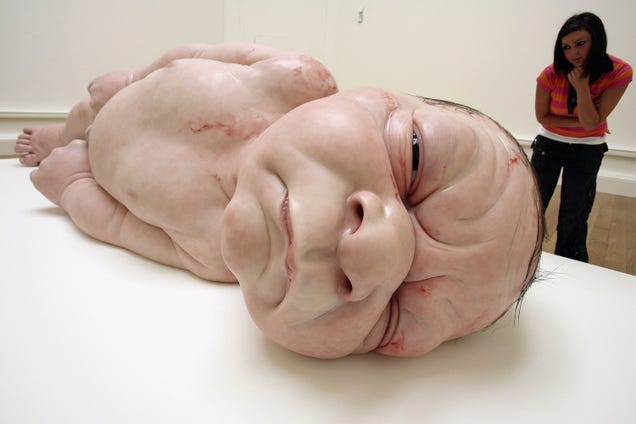
The colors and proportions used on the sculptures are perfect on each piece, but what makes them unbelievable, is their size.  Some he makes incredibly large, while others he makes pint-sized. For example, the newborn sculpture takes an entire room.  Regardless of their dimensions however, the sculptures are mind-blowing!

Mr Mueck was previously a renown model maker and puppeteer in children’s television and films. In his 30’s however, he turned into fine art for a living. He sculpts the clay, makes plaster, moulds it, and then replaces the clay with a silicone, fiberglass and resin mixture.
His techniques and skills are largely found in cinematic and theatrical special effects.
1. Woman With Shopping Bags
 Mind Blowing Sculptures That Look So Real
Image Courtesy of Francois Mori(taken from www.gizmodo.com)
2. Couple under an umbrella
 Mind Blowing Sculptures That Look So Real
Image Courtesy of Francois Mori(taken from www.gizmodo.com)
3. Young couple
 Mind Blowing Sculptures That Look So Real
Image Courtesy of Francois Mori(taken from www.gizmodo.com)
4. Youth
 Mind Blowing Sculptures That Look So Real
Image courtesy of Dan Kitwood (taken from www.gizmodo.com)
5. Drift
 Mind Blowing Sculptures That Look So Real
Image courtesy of Dan Kitwood (taken from www.gizmodo.com)
6. Still life
 Mind Blowing Sculptures That Look So Real
Image courtesy of Raoul Wega/Dan Kitwood/ (taken from www.gizmodo.com)
7. Woman with sticks
 Mind Blowing Sculptures That Look So Real
Image courtesy of www.fondation.cartier.com
8. A girl
 Mind Blowing Sculptures That Look So Real
Image courtesy of Jeff J Mitchell (taken from www.gizmodo.com)
9. Spooning couple
 Mind Blowing Sculptures That Look So Real
Image courtesy www.dailymail.co.uk
10. Two women
 Mind Blowing Sculptures That Look So Real
Image courtesy of www.brooklynmuseum.org
11. In bed
 Mind Blowing Sculptures That Look So Real
Image courtesy of www.brooklynmuseum.org
12. Mother and child
 Mind Blowing Sculptures That Look So Real
Image courtesy of Johannes Simon(taken from www.gizmodo.com)
13. Mask
 Mind Blowing Sculptures That Look So Real
Image courtesy of www.brooklynmuseum.org
14. Untitled big man
 Mind Blowing Sculptures That Look So Real
Image courtesy of www.brooklynmuseum.org
15. Boy
 Mind Blowing Sculptures That Look So Real
Image courtesy of Polfoto, Morten Overgaard/AP(taken from www.gizmodo.com
16. Dead man
 Mind Blowing Sculptures That Look So Real
Image courtesy of Raoul Wegat/ (taken from www.gizmodo.com)
17. Big baby
 Mind Blowing Sculptures That Look So Real
Image Courtesy of Peter Macdiarmid (taken from www.gizmodo.com)
(Source: www.dailymail.co.uk, www.gizmodo.com)

Senin, 30 Juni 2014

A Plant That Actually Eats Heavy Metal Has Recently Been Discovered In Philippine

Evolving of plants has seen them exclude any type of metal from their surroundings. The Rinorea Niccolifera however, is not like most plants. It was discovered in the Philippine jungles; this plant can amass up to 18,000 ppm of metal in its roots and leaves and not get poisoned. This is like 100 to 1000 times what normal plants take in. University of Philippines-Los, Banos researchers, in a new report said that its ability to accumulate such huge amounts of toxic metals could be the solution to most toxic waste sites found around the world. The discovery is therefore very important.
image source: www.takepart.com
The tree is small, 1.8 meters tall normally and with a stem that ranges from 3 to 13 centimeters in diameter.  The Niccolifera name refers to the species ability to hyper-accumulate nickel, a heavy metal, in its leaf tissues and stem.

This species is unfortunately endangered and its habitat has been termed as severely ‘fragmented’. Its recordings have so far been from three adjacent localities only, from its current location which is less than 500 km and declining. The study indicates that the species is open to industrialization and open pit mining.

It goes on to say that, since this plant species is a ‘hyper-accumulator’, it should be exploited for its accumulation traits like environmentally green technologies. This plant can be used to clean up metal filled soils and old mines. The leaves and roots can later be burned and the valuable metals gotten can be sold and re-purposed.

"Hyper accumulator plants have great potentials for the development of green technologies, for example, 'phytoremediation' and 'phytomining'," said Augustine Doronila, co-author of the paper on the plant species and a researcher at the University Of Melbourne, Australia.

Phytoremediation is the use of hyper accumulator plants to extract heavy metals from contaminated soils. On the other hand, Phytomining is the use of these plants to grow and harvest, so as to recover valuable commercial metals in the shoots of the plants in metal-rich sites.

The use of plants to extract metals from soil that’s contaminated is not new and has been used since the 1990’s. Countries that use this type of green technology include Thailand, India, Brazil and China.

We should try and save these kinds of species in their native habitat since they can be used to clean up after us. Maybe it’s time we worked with nature instead of the continuous destruction we have been subjecting it to.

“If we can understand the chemistry of how these plants can load themselves with so much nickel without being poisoned, it may help us make novel compounds to combat some degenerative disease,” Doronila said.  “If we are to allow mining or logging in these areas, we have to oblige the miners and the loggers to restore these habitats.”

Discoveries like this could be the solution to current problems we have today!

[Source www.takepart.com, www.pensoft.net, www.sciencedaily.com]